Showing posts with label Track Plan. Show all posts

Monday, October 26, 2015

"Available: One helix frame with legs... like new!"

Shortly after my Labor Day epiphany, Lance Mindheim wrote in his blog about the three basic areas of satisfaction that participants derive from the hobby, as he sees it. Emphasizing the need for self-awareness, Lance opined in his September 12, 2015 entry, "Hitting the Target of Design Success," that it is crucial to honestly evaluate that which we find most satisfying from the hobby: the visual component; the assembly component; or the operating component.

What he didn't say, perhaps because it's so obvious to everyone but me, was that advice and guidance is most relevant coming from those more experienced modelers who share similar levels of satisfaction from those three components. In other words, if you are most drawn to the visual and assembly components, like I am, it may not serve one too well to get all of their direction from those who are most interested in operating, like I did. Duh!

My 6'-3" x 6'-3" helix frame will not be used. The full assembly is available to anyone who is relatively local and is willing to handle its transport. Otherwise, it will be disassembled and the 1" x 3" clear pine will be reused somewhere, somehow inside the train room.

The removal of the helix will allow me to reconfigure my television/crew lounge and provide space for a neat workbench set-up which I'll cover in the very near future.


The reworked track plan is ongoing, but it looks like staging can be achieved by crossing the main line inside the east-end and west-end tunnels and then descend behind screening by 3% to (2) three-track staging yards. Crossovers will be added at the midway point where  the three tracks straighten out. An entry gate of undetermined design is a necessary compromise. Radii are 27, 30 and 33 inches respectively.
 
Apologies for the overall lapse in entries here on the Old Main Line and for my cancellation as a clinician at this past weekend's MER/NMRA, but family needs have zapped my time and energy. If you are fortunate enough to have/had your parents around into their 90's, you probably understand some of the daily issues that become stress-inducing and all-consuming.

In the meantime, check out Lance Mindheim's musings on the sidebar and see what he says about the areas of satisfaction. Hope to see you soon with some more updates and layout progress.

-30-
 
   BONUS:  RHETORICAL  QUESTION  OF THE  DAY... 
 
What has been the overwhelming reaction from both the railroading and dodge-ball communities to my unexpected about-face?


Thursday, May 7, 2015

"Double your pleasure... Double your run."

Obviously if a modeler with a single deck layout is unhappy with separation and run, he must revisit the multi-deck concept. I say revisit, because I had given it consideration prior to beginning this project, but ultimately decided against it.

I have all but memorized Tony Koester's book on the subject and have visited and operated on some great ones. But I've never quite been a fan of the multi-deck for my purposes. At least I don't think so. I was heartened when I read of Marty McGuirk's dismantling of his upper level and especially related to his reasons why, which he mentioned in his blog, and expounded upon in an issue of Model Railroad Hobbyist.

I do like having one deck at optimal working, viewing and operating height rather than two at compromised ones. I dislike having to worry about more lighting... and I do have to acknowledge the modest ceiling height with which I'm working. But most of all, I just prefer the look, or presentation if you will, of a single deck.

But I enlisted the help of Bob Sprague, planner extraordinaire, in a what-if, why-not scenario. I figured it's worth the beer that he charges! Hang on, here we go.

This is the upper level. The multi-deck layout plan is a point-to-point one with two major LDEs per deck. The helix forces a change in direction in this out-and-back format and is of a 'backbone' or 'spine' style. The spine serves as both support and backdrop and the loops alternate between running on the inside and outside of the spine. This alternate format provides about 8" of vertical separation so the outside loops can be sceniced. Radii are 36" and 28" respectively. Ted DiIorio details this type of helix on his blog.

This is the lower level. The depth of each deck is staggered to maximize viewing, eliminate congestion and minimize scenicing. The distance between LDEs in this plan is generous. Mainline run increases from about 90' of the single deck to almost 220' for the multi-deck.
 
To be fair to Bob, he urged a plan that utilized the helix for staging areas with return loops and consistent direction, but it required a two-level gate across the 24" entry which is a feature I really dislike. That's it for now. A lot to think about. Wouldn't mind getting some viewpoints from you all out there! Do comment.

-30-
 
  BONUS:  RHETORICAL  QUESTION  OF  THE  DAY... 
 
Did you know that you can learn more about the work of  Marty McGuirk , Bob Sprague and Ted DiIorio by clicking on the sidebars for Central Vermont Railway, Annapolis Junction Railroad and Ma & Pa Railroad respectively?

Tuesday, May 5, 2015

"Improved?... The final track plan."

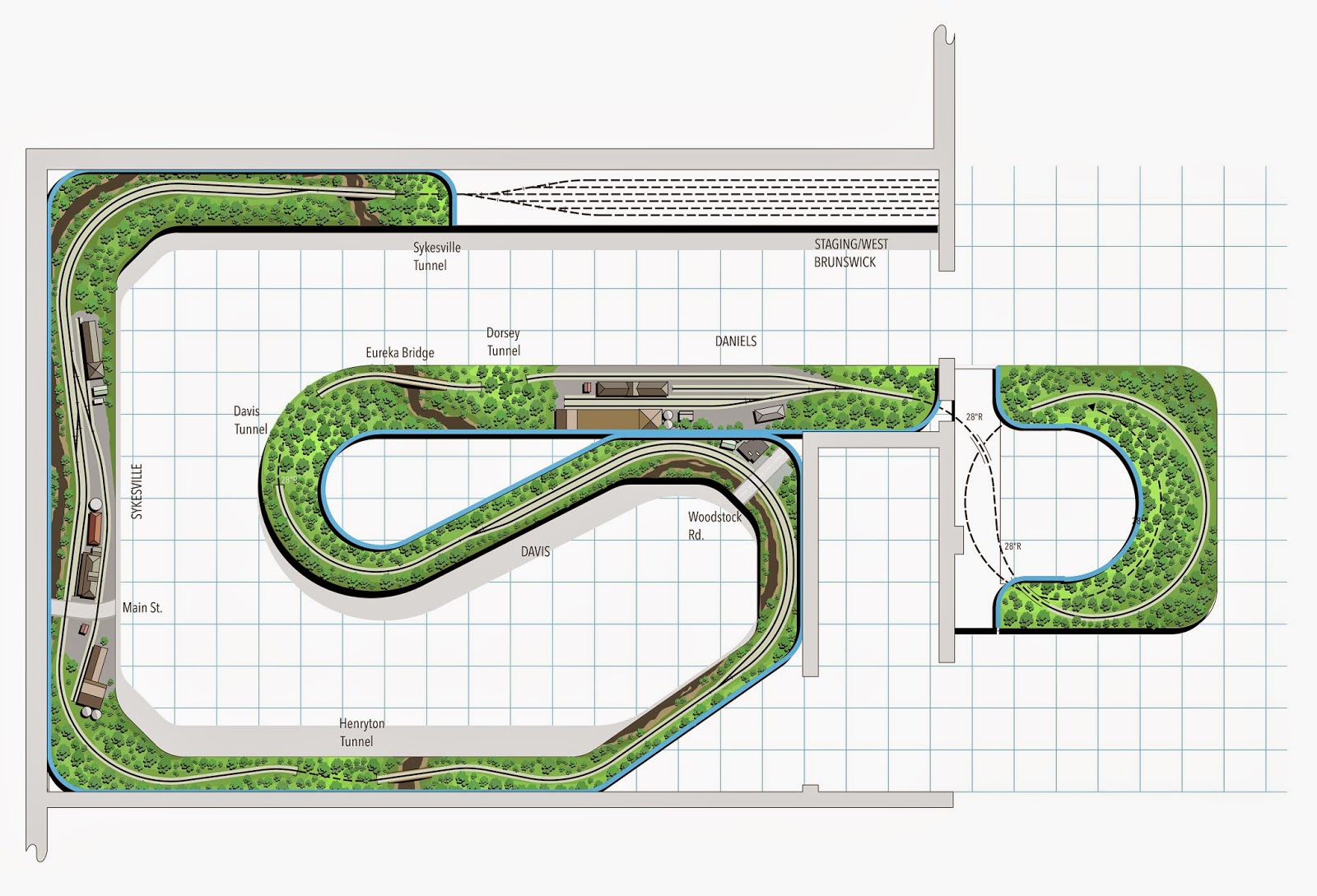
It was back to the drawing board, literally, after assessing my earlier track plan which I determined lacked adequate separation between those pesky Layout Design Elements. In consideration of my fondness for the areas that I had researched and planned, I decided to extend the layout into the finished living area with as little intrusion as possible.

I secured preliminary approval from the still-in-office Senior VP of Real Estate Distribution and Utilization with the stipulation that this would be considered 'Phase II.' This construction could not, should not and would not, proceed prior to there being significant progress made in the main layout room first. Fair enough. No complaints here.

While the first three major LDEs remained the same, Davis Siding was moved further west from the end of the peninsula to the area formerly holding Sykesville. The end of the peninsula can now be sceniced with the Eureka Bridge and Davis Tunnel (not drawn) and begin to more accurately represent the distance between Daniels and Sykesville.

The farming community of Sykesville is moved outside of the layout room via Henryton Tunnel. The new area includes a buffered staging 'pit' that does allow for through-running, plus the State Hospital spur which could not be accommodated in the earlier scheme. Entry to the layout is via a flip-up, nod-under archway @ 5'-6".

I'll need a little bit of time to really evaluate this, move some furniture around in the 'man cave' and get a true idea of how viable this is. I would really like to keep Sykesville because it represents a different aesthetic from the other LDEs. The others are all mill towns sitting in the river valley, while Sykesville begins to suggest the rolling hills of central Maryland. Plus, the different consignees offer enhanced operations. We'll see.

But For Thursday, we'll have a track plan that really represents a significant departure... and it's in color and fully rendered. Woooo hoooo! See you then.

-30-
 
  BONUS:  RHETORICAL  QUESTION  OF  THE  DAY... 
 
Did you know that Cinco de Mayo is not a celebration of Mexican independence, but one of unlikely victory over the French army at the Battle of Puebla in 1862? So...  "Happy Battle of Puebla Day!"
"You're welcome!"


Tuesday, April 28, 2015

"Finally!... The final track plan."

As a first-time layout builder I may have been a bit naïve in my expectations for the extent of the Old Main Line that I could model. After substantial research, I originally anticipated depicting the 90 miles between Baltimore, MD and Harper's Ferry, WV until an experienced modeler confided that I may want to consider Z scale, or else move my family to a warehouse. Several iterations later, I had reluctantly reduced my vision down to an 18 mile stretch between Ilchester and Sykesville, or for non-math majors, just 20% of my original intent.

My hand-drafted track plan is drawn @ 1"=1' and is pictured below. Minimum radius is 30". I plan to use Micro Engineering code 83 flex track and #6 turnouts with Midwest Products cork roadbed. Apologies for the difficulty some may have reading the full plan due to a lack of contrast. But the additional close ups of the key Layout Design Elements are more easily understood.


The track plan adheres to the 1959 valuation map exactly and includes all iconic scenes and key operational aspects for the chosen Layout Design Elements within this stretch of the Old Main Line. Room size is 15' x 21'.

The iconic tunnel/bridge/depot scene is replicated at Ilchester as trains enter the layout from staging. The two spurs are a team track and coal trestle for the Bartgis Bros. paper mill on the other side of the river depicted just west of here. The deck depth here is 20".

The eastern end of Ellicott City includes the set-out yard  and spur over the trestle to the flour mill. A team track for downtown businesses is next to the freight house. The iconic depot is next to the much-photographed overpass. Deck depth here is 28".

The west end of Ellicott City includes the Talbott Coal & Lumber dealer across from the famous hotel. Oella's LDEs are compressed into Ellicott City to create critical mass here and to gain separation elsewhere. In actuality, Oella is less than a mile up the river.

Oella's company houses and textile mill are prototypically depicted on the wrong side of the river with access via a pitched girder bridge. Included is a trailing turnout whose historical existence has been hotly debated.

The textile mill complex at Daniels gains separation from the Dickey mill via a long approach spur hugging the side of the river and past company houses before reaching the river again which surrounds the complex.

The farm community of Sykesville is reached from Daniels after the Davis siding at the end of the peninsula and serves such industries as the Maryland Milling Supply, Farm & Home Supply and Standard Oil before exiting the layout into staging via the Sykesville tunnel. Depth is 20".

While the layout's track configuration is spot-on and the iconic LDEs are pretty accurately depicted, the separation has left me dissatisfied and pretty bummed. Still too much prototype? C'mon!
 
The goal is to have a mix of switching activities, plus some lazy enjoyment watching through-trains traverse the scenes, while also complicating the switching chores. Local freights would be between 6-12 cars, while through trains would be 16-18 cars.
 
What to do? I'll follow up with some considered changes and some actual ones in the coming weeks ahead. But I'm also open to some dialog, so don't be shy in the comments section. See you next with a bit of a Public Service Announcement.  

-30-
 
  BONUS:  RHETORICAL  QUESTION  OF  THE  DAY... 
 
A little help! If the proposed final track plan does not provide adequate separation between LDE's, the best possible solution is:
A) Eliminate one or two researched, studied and beloved LDE's.
B) Expand the single deck layout into adjacent  living spaces.
C) Convert the single deck layout into a multi-deck layout.
D) You're screwed my friend. Change to N scale.